HDU vs. Wood Signs: Which Sandblasted Sign Material Is Right for You?
A sandblasted sign makes a strong first impression. Its raised lettering and carved texture give it a depth that a flat sign cannot match. Before we can carve one, though, there is a question to answer: should your sign be made from wood or HDU (high density urethane)? Both are sandblasted the same way, but they look, age, and stand up to weather very differently.
We have been building signs in Orting since 1984, and we sandblast both
wood and HDU signs in our own shop. The short version: choose wood if you want natural grain and a one-of-a-kind, rustic look and you are fine with some upkeep. Choose HDU if you want crisp painted detail, bright color, and a sign that will not rot, warp, or crack. Below, we break down the differences so you can pick the right material with confidence.
Is an HDU Sign Still a Sandblasted Sign?
Yes. HDU and wood go through the same sandblasting process. The difference is the board we start with, not the way we carve it.
Every carved sign in our shop follows the same steps:
- Design. We lay out your logo, lettering, and artwork to scale and send a full color mock-up for your approval.
- Stencil. We cut a rubber stencil of the approved artwork and apply it to the wood or HDU panel.
- Blast. The stencil protects your letters and artwork while abrasive blasting cuts away the background. That is what gives the sign its raised, dimensional feel.
- Paint and seal. We hand paint the sign in many layers of high quality paint, then finish it for outdoor life.
- Install. Our experienced team installs the finished sign on site.
On wood, the blast follows the grain. Soft growth rings wear away faster than hard ones, so the background takes on a natural, textured grain you can feel. On HDU there is no grain, so the background blasts evenly. We can leave it smooth, add a faux woodgrain texture, or give it a pebbled stone look.
How Do HDU and Wood Signs Compare Side by Side?
HDU wins on weather resistance and consistency. Wood wins on authenticity and natural character. This table covers the differences that matter most when you are choosing.
| Sandblasted wood (cedar) | Sandblasted HDU | |
|---|---|---|
| Look | Real grain, warm and rustic, every board unique | Smooth or textured; can mimic woodgrain or stone |
| Detail | Good for bold lettering and simple artwork | Holds fine lines, small text, and crisp edges |
| Moisture | Heartwood resists decay, but wood still absorbs moisture | Closed-cell material that does not absorb water |
| Cracking and warping | Can check, split, or cup over time | Will not rot, warp, or crack |
| Paint | Finish wears faster as wood moves with the seasons | Paint holds well because the board stays stable |
| Weight and size | Heavier; large signs need boards glued together | Lighter; thick, large panels come in one piece |
| Structure | Natural grain gives it strength across wide spans | Wide signs need a frame or backing for support |
| Best fit | Rustic, historic, and natural settings | Color-heavy logos, HOA and business entrances |
Which Material Holds Up Better in Western Washington Weather?
For most outdoor signs in our wet climate, HDU holds up better with less work. Wood can last a long time too, but it needs more care to get there.
HDU is a closed-cell foam board. One major HDU manufacturer, Precision Board, explains that its cells are separate from each other, so the board
absorbs no ambient moisture and does not swell, warp, or crack from rain. Because the board stays still, the paint on top lasts longer too. Months of rain, freeze, and thaw are not much of a threat to a well-primed and painted HDU sign.
Cedar is one of the better woods for outdoor signs. The USDA Forest Products Laboratory's
Wood Handbook lists the heartwood of several cedars, including western redcedar, among the decay-resistant woods. The same chapter cautions that decay resistance varies from board to board and drops in warm, damp conditions. Wood also swells and shrinks as it takes on and loses moisture. Over many seasons that movement can open small cracks and wear down the paint, which is why a cedar sign needs periodic touch-ups to stay sharp.
When Is a Sandblasted Wood Sign the Better Choice?
Pick wood when the natural material is the point. No coating fully copies the depth of real grain, and many customers want that authenticity.
Wood makes sense when:
- The setting is rustic or historic. Cabins, lodges, farms, wineries, trail heads, and parks often look most natural with a real wood sign.
- You want each sign to be one of a kind. The grain on every board is different, so no two signs come out the same.
- You like a sign that ages. Wood weathers and gains character over the years. Some owners love that patina.
- You plan to keep up with maintenance. A wood sign stays sharp with a fresh coat whenever the finish starts to wear.
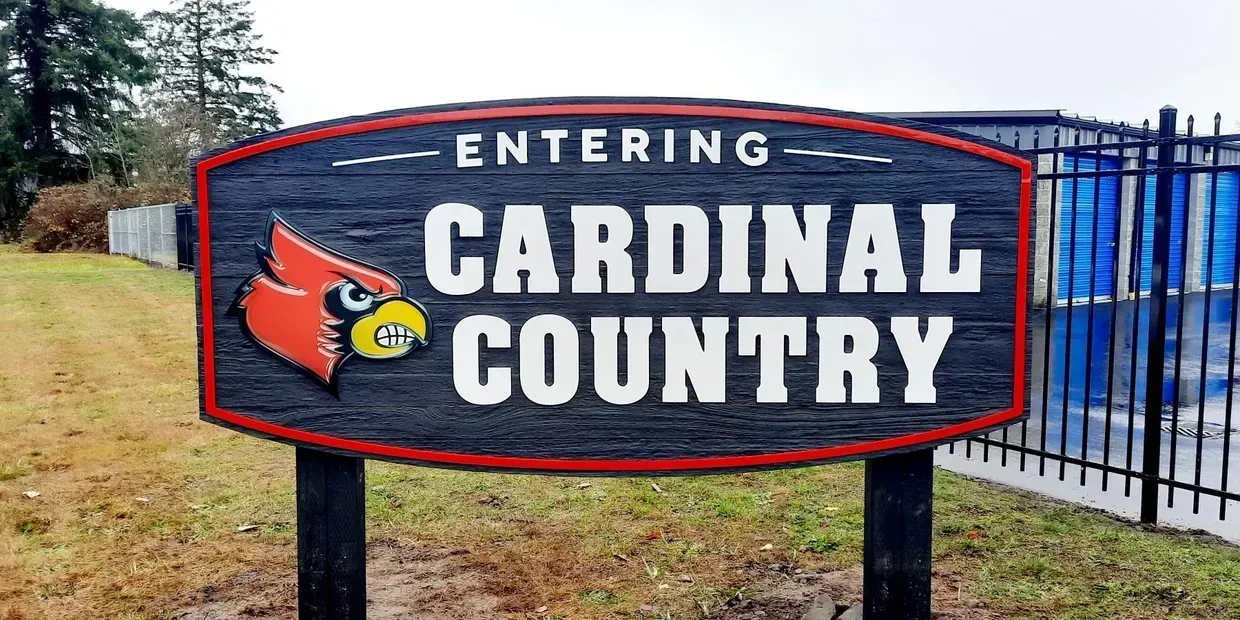
One example from our shop is the custom wood carved sign we built for Glacier West Storage. It honors the Orting High School mascot, and the carved grain gives it a classic, hometown look.
When Is an HDU Sign the Better Choice?
Pick HDU when you want a sign that keeps its crisp look for years with very little upkeep. It suits most business and community entrance signs.
HDU makes sense when:
- Your logo has fine detail or bright color. HDU holds small lettering and sharp edges well, and it takes paint evenly.
- The sign faces heavy weather. Rain, sprinklers, and shade from trees are tough on wood but easy on HDU.
- You want the wood look without the wood problems. We can blast a faux woodgrain texture into HDU, or give it a pebbled stone finish.
- The sign is large or thick. HDU comes in big, thick sheets, so a large sign does not need to be glued up from smaller boards. Precision Board lists its standard sandblasting grade at about 15 pounds per cubic foot, compared with about 26 for redwood.
- It is a neighborhood or HOA sign. Entry monuments for subdivisions and HOAs need to look good for a long time without a big maintenance budget.
One tradeoff: HDU does not have wood's natural grain strength, so wide signs need a metal frame, an edge band, or a backing panel. We build that support into the design so you never see it.
Does HDU Cost More Than a Wood Sign?
Sometimes, but not always. The price of any carved sign depends far more on its size, thickness, design detail, number of colors, and installation than on the board itself.
HDU can cost more per square foot than some woods. On larger signs it can close that gap, because the panel comes ready to blast without gluing and surfacing several wood boards together. HDU also tends to save money over the life of the sign, since it needs less upkeep in a wet climate.
Every sign we make is custom, so we do not list prices online. The best way to compare is to ask us to quote the same design in both materials. You will see the difference in cost and get our honest opinion on which one fits your site.
Frequently Asked Questions
Can you make an HDU sign look like real wood?
Yes. We blast a woodgrain texture into the HDU background, then hand paint it in wood tones. From the street, a faux woodgrain HDU sign reads as carved wood. Up close, real wood still has a depth and variation that a texture cannot fully match.
Can you repaint or restore an old sandblasted sign?
Often, yes. Many faded wood signs can be cleaned, repaired, and repainted to look close to new, and restorations are part of the work we do. Send us a photo and we will tell you whether restoring your sign makes more sense than replacing it.
How long does it take to make a sandblasted sign?
Most of our standard projects take one to three weeks after you approve the design. Larger signs, monuments, and complex artwork can take longer. We will give you a timeline with your quote.
Can a sandblasted sign be lit?
Yes. Sandblasted wood and HDU signs are often paired with ground-mounted spotlights so the raised lettering casts shadows and stands out at night. If you want a sign that glows on its own after dark, take a look at our lighted sign options.
Frequently Asked Questions
Still not sure which material fits? We will help you choose based on where the sign will stand, how much sun and rain it gets, the look you want, and the upkeep you are ready for. We serve
Pierce and King County and take on select projects across Washington.